AI overviews take the top spot on a considerable amount of Google searches these days.
According to a recent report from Semrush, in March 2025, AI overviews were found to trigger on around 13% of searches. This number has doubled since January 2025, when AI overviews only triggered on around 6.5% of searches.
How do you show up in Google AI Overviews?
There isn’t a special trick to getting your website into a Google AI Overview.
Google still needs to be able to find your website, understand what your content is about and trust the information you’re providing.
That means good SEO is still the starting point.
If you want to increase your chances of appearing in Google AI Overviews:
- Create genuinely useful content around the questions your customers are searching for.
- Answer those questions clearly and directly.
- Structure your content so Google can easily understand it.
- Use your own experience, expertise, examples and data wherever possible.
- Build your website’s authority around the subjects you want to be known for.
- Make sure Google can crawl and index your important pages.
There’s no guaranteed way to get into an AI Overview. But if you’re already investing in good SEO and useful content, you’re probably closer than you think.
Google doesn’t only use huge, well-known websites in its AI Overviews
What matters is whether your page provides useful, relevant and trustworthy information that helps answer the searcher’s question.
That’s good news for smaller businesses.
You don’t need to be the biggest website in your industry. You need to have a website that shows you know what you’re talking about and create content that gives people genuinely useful answers.
What are AI Overviews (AIOs)?
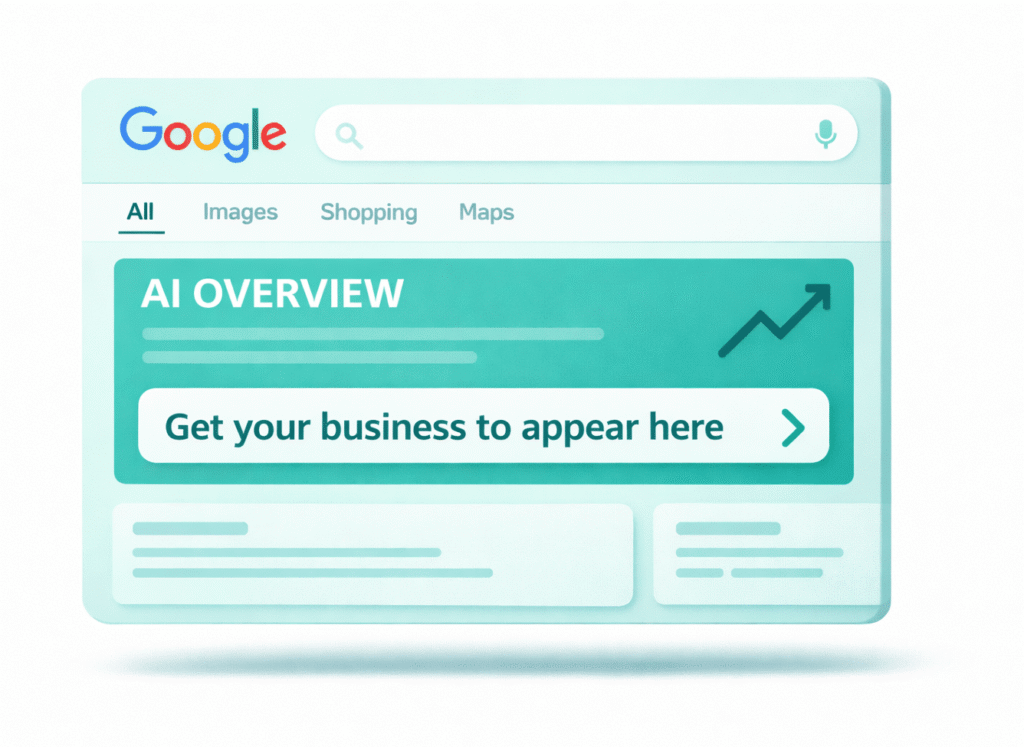
AI overviews, or AIOs, are AI-generated summaries featured at the top of the results page. Officially introduced in May 2024, Google uses AIOs to answer user queries directly.
To do this, AIOs pull information from a selection of websites that appear on the results page. If a website is used as a source, the AIO will also link to it at the top of the page.
But there’s one very important fact to keep in mind here: AIOs only pull from sources that Google considers to be of high authority.
Why you should want your website to be show up in an AI Overview
Search Engine Optimisation (SEO) is for ranking on search engines, like Google and Bing. The higher up you are on the search results, the more likely your website is to be seen and visited.
AIOs appear at the top of the search results, with links to the sources that provided the information capable of answering the user’s query.
Being featured in an AIO highlights you above every other link on the results page.
And remember: being featured in an AIO is a sign that your website has high quality, trustworthy content.
What do you need to do to show up in Google’s AI Overviews?
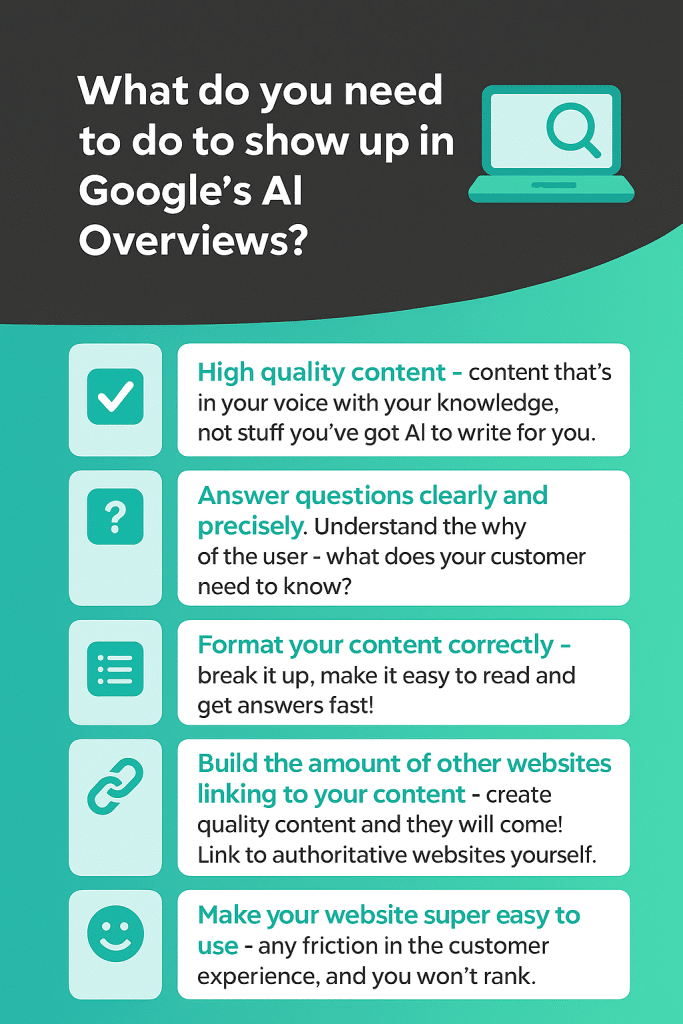
Here are my top 7 recommendations to getting yourself showing in Google AI Overviews
1. Get the SEO basics right
Google needs to crawl, index and understand your website before it can surface your content.
2. Answer specific questions your customers are asking
Don’t just target broad keywords. Build content around actual problems and questions.
3. Give the answer clearly
Put concise answers directly underneath relevant headings rather than burying the answer six paragraphs down.
4. Add something that only you can provide
Your experience, opinions, examples, customer questions, case studies and first-party data make your content more useful.
5. Build authority around your subject
Don’t publish one article and expect Google to consider you an expert. Build a connected library of useful content.
6. Structure your content properly
Clear headings, short paragraphs, lists, tables and FAQs make information easier for both people and search engines to understand.
7. Keep your content up to date
AI search is evolving quickly. Revisit important content and make sure examples, statistics and recommendations are still accurate.
What does AI search visibility actually look like?
It’s all well and good me telling you that getting your website into Google’s AI search results is important. But is it actually happening for small businesses?
I decided to look at my own website data to find out.
Over the last three months, TJ Creative appeared more than 23,000 times across Google’s generative AI search features.
That’s an average of more than 250 appearances every day.
Now, that doesn’t mean 23,000 people visited my website or that I suddenly received thousands of enquiries.
An impression simply means my website had an opportunity to be seen within those search results.
But that’s still important.
Before someone can visit your website, enquire about your services or buy from you, they need to discover that your business exists in the first place.
What content was Google finding?
This was probably the most interesting part for me. The pages receiving the most impressions weren’t pages stuffed with clever AI tricks.
They were useful articles answering questions people genuinely search for.
For example, some of my most visible content covered:
- how much freelance copywriters charge
- the best SEO tools
- how much SEO costs in the UK
- how to repurpose content
- how to hire an SEO expert
My five most visible pieces of content accounted for around 60% of my AI search impressions.
There’s a pretty simple lesson here for business owners: Answer the questions your customers are asking.
Think about what people ask before they buy from you. What does it cost? How does it work? Which option should they choose? What should they look out for?
Then create genuinely useful content that answers those questions.
You don’t need to become an AI expert.
You need to become a useful source of information about the thing you already know better than most: your business and industry.
Is SEO for AI Overviews different from normal SEO?
Not as much as you might think.
You don’t need to throw away everything you’ve learned about SEO and start again because AI has arrived.
The foundations are largely the same: create a website Google can understand and fill it with genuinely useful content that demonstrates your expertise.
The difference is how people are searching.
Instead of typing a couple of words into Google, we’re increasingly asking longer, more specific questions and expecting an immediate answer.
That’s why I’d focus less on creating a page for every individual keyword and more on becoming the best source of information around the problems your customers are trying to solve.
Good SEO gets your business found.
Good content gives Google – and its AI – a reason to use you as the answer.