In the world of AI tools, there’s one name that comes up more than any other: ChatGPT
SEO used to all be about Google. Now it isn’t. “Google it” is now being rivalled by “ChatGPT it”.
Let me be frank – all ChatGPT and the other AI/LLMs do is use website content (yes, YOUR content) to pull together an answer for its user.
It can also summarise various bits of content, like blog posts, news reports, and even visual media like Youtube videos.
And there’s another sweet trick up its sleeve. ChatGPT can also make recommendations.
If someone wants to know if there are any good places to grab a coffee nearby, they could ask ChatGPT for the best place to go.
But why does being mentioned in ChatGPT matter to your business?
The answer: AI tools drive brand awareness, build trust, and even sends traffic to your website – and leads/enquiries and even sales!
That’s right, ChatGPT is another area where you can grow your business through SEO. And it works:
TJ Creative Founder, Tom Blake: “ChatGPT will both reduce the amount of traffic you see coming to your website… but it also has the power to send you website traffic, and even better, send you prospects who are ready to convert.
In fact, one of the brands I work with, a leading workwear. & PPE supplier, converted a lead that came from ChatGPT. That client is now worth £20,000 per year for them!
All because that end user asked Chat a question, and it led them to the company’s website.”
The best thing, you can also start making use of ChatGPT traffic to grow your business.
How to get your business mentioned on ChatGPT
With around 2.5 billion daily prompts across the globe, ChatGPT provides a lot of marketing potential.
But to be in with a chance of appearing in a ChatGPT generation, you’ll need to focus on your SEO and content.
Here’s what we recommend to get noticed – and it works:
Create clear, helpful content
If a customer asked you a question, what would you say to them? You’d answer their question, of course, with as much detail as you believe they need to know.
Write your content in exactly the same way: clear, direct, and helpful. And don’t forget the golden rule: answer real questions that your customers have.
Create ‘How to’ guides for step by step instructions, and end your content with FAQs to keep things quick and simple.
When formatting your content, use clear headings and short sections for an accessible structure.
Share unique knowledge
Think about that conversation with a customer that we mentioned above. You’d use your own experience to answer their question – not only because you’re an expert, but because they’ve come to you for that expertise.
Share this unique knowledge in your online content.
Your experience includes:
- Any research you’ve done over the years.
- Tips that work for you, and would be invaluable for someone else to hear about.
- Your actual real life experiences and hypothesis.
This is one of the most crucial factors for ChatGPT visibility. AI tools prefer content that adds something new, not just repeats what’s already out there.
Keep your content up to date
Fresh content is relevant content. Make sure you update your blogs regularly to include new information.
You should also highlight your updates. Use a ‘Last Updated’ note at the top of your posts, so AI tools can quickly identify how recent and trustworthy your content is.
Make it easy to read and use
You’re an expert. You know the industry jargon like the back of your hand.
Online users don’t – and neither do AI tools.
Use plain language as much as possible. Break down complex information into simple parts, and use real world examples to demonstrate them.
In terms of how you format and structure your content:
- Use bullet points wherever you can – everyone pays attention to a bullet point!
- Summarise your information at the end of the article, or even the end of every section.
Build trust across the web
Imagine you were looking to hire a plumber. You go to Google, and it presents two options – one with 10 reviews, the other with 50 reviews.
Which one are you more likely to choose?
The one with more reviews.
More people have used their services, so there’s a better guarantee of value and quality.
The same goes for your content. Build trust across the web by getting other websites to link it.
The more links you have, the more people have found your content useful and helpful. They’re even willing to directly connect it with their own viewers.
And that’s not all you can do to try and build credibility:
- Get featured on podcasts.
- Be interviewed for news articles.
- Write blogs for other industry websites.
Use structured content where you can
All this talk of clear and structured content, but what does it really mean?
It’s nowhere near as technical as a lot of websites make out. You don’t need to dig around in your source code or add new blocks to it – whatever that actually means!
You just need to format your content cleanly. Make it as easy as possible for someone to find what they’re looking for with content that answers their question, and then format it for quick and easy scanning.
Use subheadings, bullet points, and if possible, include an FAQ section at the end.
Get found on multiple platforms
Sharing content in more than one place is a good online marketing strategy full stop. More places, more eyes, more chances for customer conversion.
But when you’re trying to get mentioned by AI tools, it’s key to represent your content in as many forms as possible.
AI doesn’t just learn from websites. It also learns from content shared on YouTube, LinkedIn, and other trusted directories.
Repurpose your written content. For example, a blog post could be turned into a video script, which can then be turned into a simple, shareable infographic for social media.
What you should avoid
In creating content that’s more likely to get you mentioned by AI tools, there are a few traps you should be sure not to fall into.
To start with, remember that you’re writing for humans first and foremost. You’re not just writing for search engines or ChatGPT. Your primary focus should be creating for the real end user.
Within this, you should also avoid mistakes like these:
- Keyword stuffing
- Clickbait headlines that offer no value
- Publishing a post and then never coming back to update it
What success looks like
As we said at the beginning, you can start to see people landing on your website from ChatGPT. And even see those visits turn into an enquiry or sale too!
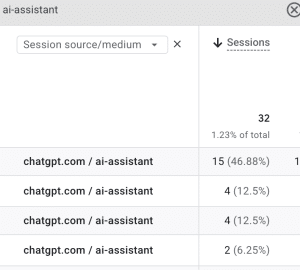
If you have Google Analytics set up you’ll be able to see ChatGPT and AI assistants as the source. Like so:
A ChatGPT mini case study
A client of ours last month saw x7 conversion from ChatGPT users – which made up just 6.3% of their total enquiries last month. All thanks to SEO!
In the last month, the conversion rate of ChatGPT traffic is 46% – this is an unreal conversion rate!
AI visibility is becoming easier to see
One of the difficult things about AI search is knowing whether your efforts are actually working.
With your website, you can normally look at things such as visitors, Google rankings, clicks and enquiries.
AI hasn’t always been quite so easy to measure… that’s beginning to change.
Google, for example, is giving us more information about how websites are appearing across its generative AI search features.
I recently looked at this data for the TJ Creative website and found that, over three months, my content had generated more than 23,000 impressions across Google’s generative AI features.
That’s Google rather than ChatGPT, so it’s important not to treat the two as the same thing.
But it does give us an interesting glimpse into how the way people discover businesses is changing.
Your website content isn’t only there for someone who searches Google, clicks a traditional blue link and lands on your website.
The information you publish can now help your business appear in different types of search results and AI-powered experiences too.
That’s another reason why I believe businesses should continue investing in genuinely useful website content.
The more useful information you put out there, the more opportunities you give your business to be discovered.
A quick recap
ChatGPT could mention your business to its users, but you need to be discoverable first.
Create helpful, valuable, and easy to read content that serves your customers. Update your content regularly, share it on multiple platforms, and get featured on other sites across the web.
Above all, don’t just write in the hope that an AI tool will pick it up. There’s no magic in the algorithm here. You need to be genuinely helpful and credible online.
And your website’s SEO needs to be top level. If your website’s SEO is strong, you’re more likely to be seen as a trustworthy website for ChatGPT to reference.
Need help making your content AI‑friendly?
Talk to us at TJ Creative.
Tom is winning with multiple businesses when it comes to their SEO and getting them featured on ChatGPT. Winning a £20,000 customer and seeing x7 enquiries from another client is a real achievement.